

Universal Driver's License Required?
The Definitional Chain: Statutory Construction, Commercial Nexus, and the False Premise of Universal Licensing


A Rebuttal to the Claim That Driver’s Licenses, Vehicle Registration, and Certificates of Title Apply to Private Travel Independent of Commercial Activity
I. Introduction: An Argument That Must Be Answered
Among the counter arguments most frequently deployed by law enforcement officers, municipal court judges, and private training entities such as Lexipol Media Group, one stands out for its apparent simplicity and its structural dependence on a misreading of statutory text. The argument is this: a standard driver’s license is entirely distinct from a commercial driver’s license (CDL). The CDL, it is said, governs commercial trucking and hazardous materials transport. The standard driver’s license, by contrast, governs the everyday travel of the people, private, non-commercial, and universally required. From this premise, the argument extends to certificates of title and vehicle registration: these requirements, it is asserted, attach to all conveyances used on the public right-of-way, independent of any commercial nexus, because the legislature has simply chosen to regulate all use of public roads as a matter of public safety.
This argument sounds reasonable on its surface. It is the argument that most law enforcement officers have been trained to accept, and it is the argument that most judges apply without examination. It is also, when subjected to the established canons of statutory construction, demonstrably false.
The falsity does not arise from a fringe interpretation or a novel legal theory. It arises from the application of rules that every first-year law student learns: that a statute must be read as a whole; that terms of art carry the meaning assigned to them by the legislature; that a word is known by the company it keeps (noscitur a sociis); that where a general term follows specific terms, it is limited to the same class (ejusdem generis); and that the expression of one thing excludes others (expressio unius est exclusio alterius). When these rules are applied to the definitional chains embedded in federal and state vehicle codes, the commercial limitation on every regulated term like “driver,” “operator,” “motor vehicle,” “vehicle,” “license,” “certificate of title,” “registration” is not merely plausible; it is the only reading the text supports.
This analysis examines those definitional chains across federal law and six representative state jurisdictions: California, Texas, Florida, New York, West Virginia, and the federal framework under Title 18 and Title 49 of the United States Code. It then addresses the certificate of title and registration arguments directly, demonstrating that those requirements are equally embedded in commercial definitions. It concludes by applying the canons of construction to the specific counter argument; that a driver’s license is not a commercial driver’s license and showing that this argument, when traced to its statutory source, collapses.
II. The Supremacy of the Common Law: Reception Statutes and Constitutional Guarantees
Before any specific vehicle code definition can be analyzed, the foundational layer of state law must be established. A frequent error in statutory interpretation, particularly in the context of law enforcement training, is the presumption that statutes exist in a vacuum, entirely displacing the common law. To the contrary, almost every state in the union explicitly declares that the common law is the supreme rule of decision, and that statutes are merely supplemental or corrective to that common law baseline. This principle is codified in “reception statutes” and constitutional provisions that adopt the common law of England as the operative law of the state.
When a fundamental right, such as the right of locomotion, exists at common law, a state statute cannot silently abrogate it. Any statute that touches upon a common law right must be read in harmony with the common law unless the legislature explicitly declares an intent to abrogate it.
A. The Reception Statutes
Every jurisdiction analyzed in this analysis has explicitly adopted the common law as its rule of decision. These reception statutes mandate that the common law prevails unless explicitly contradicted by the state constitution or a specific legislative act.
California: The California Civil Code establishes the common law as the rule of decision in all courts of the state:
“The common law of England, so far as it is not repugnant to or inconsistent with the Constitution of the United States, or the Constitution or laws of this State, is the rule of decision in all the courts of this State.” [1]
Texas: The Texas Civil Practice and Remedies Code explicitly adopts the common law:
“The rule of decision in this state consists of those portions of the common law of England that are not inconsistent with the constitution or the laws of this state, the constitution of this state, and the laws of this state.” [2]
Florida: The Florida Statutes declare the common law to be in force:
“The common and statute laws of England which are of a general and not a local nature, with the exception hereinafter mentioned, down to the 4th day of July, 1776, are declared to be of force in this state; provided, the said statutes and common law be not inconsistent with the Constitution and laws of the United States and the acts of the Legislature of this state.” [3]
West Virginia: The West Virginia Code similarly adopts the common law:
“The common law of England, so far as it is not repugnant to the principles of the Constitution of this state, shall continue in force within the same, except in those respects wherein it was altered by the general assembly of Virginia before June 20, eighteen hundred and sixty-three, or has been, or shall be, altered by the Legislature of this state.” [4]
B. Constitutional Preservation of the Common Law
Beyond statutory adoption, state constitutions frequently elevate the preservation of the common law to an organic guarantee. This means that the legislature’s power to alter the common law is itself constrained by constitutional limits.
New York: The New York Constitution explicitly preserves the common law as the law of the state:
“Such parts of the common law, and of the acts of the legislature of the colony of New York, as together did form the law of the said colony, on the nineteenth day of April, one thousand seven hundred seventy-five... shall be and continue the law of this state, subject to such alterations as the legislature shall make concerning the same. But all such parts of the common law, and such of the said acts, or parts thereof, as are repugnant to this constitution, are hereby abrogated.” [5]
C. The Implication for Statutory Construction
The existence of these reception statutes and constitutional provisions creates a structural barrier to the silent expansion of regulatory statutes. Because the common law is the baseline rule of decision, any statute that purports to regulate a common law right, such as the right of locomotion on the public highway, must be strictly construed.
If a state vehicle code uses a term like “motor vehicle” or “driver” without explicitly declaring an intent to abrogate the common law right of private travel, the statute must be read in a way that preserves the common law right. The common law recognizes the distinction between a private traveler exercising a fundamental right and a commercial carrier exercising a licensed privilege. Therefore, the reception statutes require that ambiguous or silent vehicle code definitions be interpreted to maintain that distinction, rather than to silently obliterate the common law right in favor of universal commercial regulation.
III. The Hierarchy of Definitional Authority: General Titles, Original Meaning, and the Doctrine of Explicit Nullity
Again, before examining the specific vehicle codes, it is necessary to establish the hierarchy of definitional authority. The false premise of universal licensing often relies on reading terms like “person,” “resident,” “State,” or “United States” according to their modern colloquial usage, ignoring the strict hierarchy of statutory construction. It also relies on the false assumption that a legislature can silently redefine a term that has an established original legal meaning without explicitly abrogating that prior meaning.
When a term is used in a state statute, its meaning is determined by a rigid order of operations:
The Specific Statute: If the specific chapter or section defines the term, that definition controls exclusively within that scope.
The General Title: If the specific statute is silent, the definition in the state code’s General Provisions or General Title controls (e.g., California Government Code, Texas Government Code Chapter 311, West Virginia Article 2-2).
Federal Conformity: If the state code is entirely silent, but the statute implements a federally funded regulatory framework (such as the Surface Transportation Assistance Act), the federal definition controls (in pari materia).
Original Meaning and the Law of Nations: If no statutory definition exists, the term must be read according to its original legal meaning at the time the framework was established, as documented in foundational authorities like Bouvier’s Law Dictionary (1856) or Vattel’s The Law of Nations (1758).
A. The General Title Limitations
Every state code contains a general title that limits the construction of terms throughout the code unless specifically overridden.
For example, when a vehicle code regulates a “person,” the lay reader assumes this means a man or woman. But the general titles of state codes consistently define “person” as an artificial or commercial entity, or a “natural person” acting in a commercial capacity.
Texas Government Code § 311.005(2): “’Person’ includes corporation, organization, government or governmental subdivision or agency, business trust, estate, trust, partnership, association, and any other legal entity.” [6]
California Government Code § 17: “’Person’ includes any person, firm, association, organization, partnership, business trust, corporation, or company.” [7]
Florida Statutes § 1.01(3): “The word ‘person’ includes individuals, children, firms, associations, joint adventures, partnerships, estates, trusts, business trusts, syndicates, fiduciaries, corporations, and all other groups or combinations.” [8]
West Virginia Code § 2-2-10(a)(9): “’Person’ or ‘whoever’ includes corporations, societies, associations and partnerships, and other similar legal business organizations.” [9]
Under the canon of noscitur a sociis (a word is known by the company it keeps), a “natural person” included in a list of artificial, commercial, and governmental entities is understood to be acting in the same capacity as those entities, as a commercial actor or agent, not as a man or woman in their private capacity.
B. The Three Meanings of “United States” and “State”
The terms “United States” and “State” are not monolithic. As the Supreme Court established in Hooven & Allison Co. v. Evatt, 324 U.S. 652 (1945), the term “United States” has three distinct legal meanings:
The sovereign nation in international law.
The sovereign territory of the several states united under the Constitution.
The municipal corporation acting as the government of the federal territories and the District of Columbia. [10]
When a general title defines “State” (capitalized), it frequently refers to the third meaning, the municipal corporation and its subdivisions. For example, when a statute defines a “resident” of the “State,” it is often defining a resident of the municipal corporation (a franchise or commercial nexus), not an inhabitant of the geographic landmass.
C. Resident, Inhabitant, and Domicile
The distinction between an inhabitant (a man or woman living on the land) and a resident (a term of art implying a commercial or jurisdictional nexus) is foundational to original legal meaning.
Inhabitant: According to Bouvier’s Law Dictionary (1856), an inhabitant is “one who has his domicile in a place; one who has an actual fixed residence in a place.” It implies a permanent, lawful presence on the land as a matter of right. [11]
Resident: A resident, by contrast, is one who resides in a place for a time, often for commercial or statutory purposes. In federal tax law, for example, “residence” is determined by a presence test for aliens (26 C.F.R. § 1.871-2(b)), establishing a jurisdictional nexus for taxation. [12]
Domicile: Vattel’s The Law of Nations defines domicile as a fixed residence with the intention of always staying there. A man or woman may be domiciled on the land of a state republic (an inhabitant) without being a “resident” of the municipal corporation (”the State”) for statutory purposes. [13]
When a vehicle code requires a “resident” to obtain a driver’s license within 30 days, it is invoking the statutory, commercial definition of resident under the general title, not the original meaning of an inhabitant exercising the right of locomotion.
D. The Doctrine of Explicit Nullity
A critical principle of statutory construction is that a legislature cannot silently redefine a term that has an established original legal meaning. When a legislature wishes to change the established legal meaning of a term of art (one that has been defined by common law, the law of nations, or prior statute), it must do so explicitly through a decree of nullity.
This requirement is grounded in two foundational doctrines:
Statutes in Derogation of the Common Law: Statutes that alter or abrogate common law rights must be strictly construed. As Sutherland’s Statutory Construction notes, an intent to change the common law will not be presumed from ambiguous statutory language. The abrogation must be explicit. [14]
Legislative Presumption: The legislature is presumed to know existing law when it legislates. Morissette v. United States, 342 U.S. 246 (1952). If the legislature uses a term with an established common law meaning, it is presumed to have adopted that meaning unless it explicitly states otherwise. [15]
A silent redefinition, where a new statute simply uses a term like “transportation” or “resident” without acknowledging or displacing its prior, narrower meaning does not accomplish the change. The original meaning survives.
E. Constitutional Compliance and Strict Scrutiny
Even an explicit redefinition through a decree of nullity is void if it violates constitutional protections. The constitutional avoidance doctrine requires courts to construe statutes to avoid constitutional conflicts whenever possible.
If a legislature attempts to redefine “travel” as “transportation,” or “inhabitant” as “resident,” in a way that converts a constitutionally protected right into a licensed privilege, that redefinition must survive strict scrutiny because it burdens a fundamental right.
The Supreme Court has repeatedly affirmed that the right of locomotion is a fundamental constitutional right. Crandall v. Nevada, 73 U.S. 35 (1868); Kent v. Dulles, 357 U.S. 116 (1958). [16] [17] The Court has never held that this right can be converted into a licensed privilege by statutory redefinition alone. As the Court noted in Murdock v. Pennsylvania, 319 U.S. 105 (1943) [18], “A state may not impose a charge for the enjoyment of a right granted by the federal constitution.“ [19]
Therefore, when a state vehicle code uses broad language that might be read to encompass private travel, the constitutional avoidance doctrine requires the court to adopt the narrower, commercial reading because reading the statute to require a license for the fundamental right of locomotion would immediately trigger, and likely fail, strict scrutiny. The commercial limitation is not merely a matter of statutory definition; it is a constitutional necessity.
V. The Canons of Statutory Construction: The Tools of Analysis
There is another evaluation that must be completed before reviewing any statutes; it is necessary to establish the analytical framework. These are not invented rules. They are the foundational principles of statutory interpretation recognized by the Supreme Court of the United States and by every state appellate court in the nation.
The Whole-Statute Rule. A statute must be read as a whole, with each provision interpreted in light of the others. King v. Burwell, 576 U.S. 473 (2015). A court may not read a single subsection in isolation from the title, chapter, and article in which it appears. The scope of a title limits the scope of every provision within it.
Noscitur a Sociis. A word is known by the company it keeps. When a term appears in a list, its meaning is informed by the other terms in the list. Gustafson v. Alloyd Co., 513 U.S. 561 (1995). When “natural person” appears in a list alongside “firm,” “corporation,” “association,” and “partnership,” the natural person is understood to be acting in the same commercial capacity as those artificial entities.
Ejusdem Generis. Where a general term follows a list of specific terms, the general term is limited to the same class as the specific terms. Circuit City Stores, Inc. v. Adams, 532 U.S. 105 (2001). Where a general term precedes specific terms, the specific terms limit the general.
Expressio Unius Est Exclusio Alterius. The expression of one thing implies the exclusion of others. Leatherman v. Tarrant County Narcotics Intelligence and Coordination Unit, 507 U.S. 163 (1993). Where a statute expressly exempts certain activities from its scope, the absence of an exemption for other activities does not mean those activities are included; it means the legislature chose not to address them.
Terms of Art. Where a legislature assigns a specific definition to a term, that definition governs throughout the statute. Morissette v. United States, 342 U.S. 246 (1952). The common meaning of a word is displaced by its statutory definition.
These five canons, applied consistently, produce the analysis that follows.
VI. The Federal Baseline: Title 18 and Title 49
A. The Commercial Definition of “Motor Vehicle” in Title 18
The starting point for any analysis of vehicle regulation is the federal definition of “motor vehicle” in Title 18 of the United States Code, which governs federal crimes and criminal procedure. Title 18, Chapter 2 addresses aircraft and motor vehicles. Section 31 provides the definitions applicable to that chapter.
18 U.S.C. § 31(a)(6) defines “motor vehicle” as:
“every description of carriage or other contrivance propelled or drawn by mechanical power and used for commercial purposes on the highways in the transportation of passengers, passengers and property, or property or cargo.” [20]
This definition is not ambiguous. A motor vehicle, in the federal statutory sense, is a contrivance used for commercial purposes. The definition does not include private conveyances used for personal travel. The legislature knew how to include private use; it chose not to.
The statute defines “commercial purposes” with equal precision. 18 U.S.C. § 31(a)(10) provides:
“The term ‘used for commercial purposes’ means the carriage of persons or property for any fare, fee, rate, charge or other consideration, or directly or indirectly in connection with any business, or other undertaking intended for profit.” [20]
The phrase “or directly or indirectly in connection with any business, or other undertaking intended for profit” is broad, but it is not unlimited. It requires a nexus to profit-seeking activity. A man or woman traveling from home to a friend’s house, to a place of worship, or to a public park is not engaged in an undertaking intended for profit. The definition does not reach that activity.
B. Title 49 and the Distinction Between a Driver’s License and a CDL
Title 49 of the United States Code governs transportation. Chapter 313 addresses commercial motor vehicle safety. The definitions in 49 U.S.C. § 31301 are critical because they establish the federal framework that states must follow to maintain highway funding under the Surface Transportation Assistance Act.
49 U.S.C. § 31301(3) defines “commercial driver’s license” as:
“a license issued by a State to an individual authorizing the individual to operate a class of commercial motor vehicles.” [21]
49 U.S.C. § 31301(6) defines “driver’s license” as:
“a license issued by a State to an individual authorizing the individual to operate a motor vehicle on highways.” [21]
The counter-argument seizes on this distinction: the CDL authorizes “commercial motor vehicles,” while the standard driver’s license authorizes “motor vehicles.” Therefore, the argument goes, the standard driver’s license applies to non-commercial vehicles.
This argument fails the whole-statute rule immediately. The term “motor vehicle” in the driver’s license definition does not exist in a vacuum. It is a term of art defined elsewhere in the code. At the federal level, “motor vehicle” is defined in 18 U.S.C. § 31(a)(6) as a contrivance used for commercial purposes. The CDL and the standard driver’s license are not a commercial/non-commercial pair; they are a heavy-commercial/light-commercial pair. Both authorize the operation of commercial contrivances. The CDL authorizes the heavier class (typically over 26,001 pounds gross vehicle weight, or carrying hazardous materials, or transporting 16 or more passengers). The standard driver’s license authorizes the lighter class. The commercial nexus is present in both.
C. The Federal Highway Program and State Conformity
The states are not free to define these terms however they choose. Under 23 U.S.C. § 101 et seq., states that accept federal highway funds, which is every state, must conform their traffic laws to federal standards. The Federal Highway Administration (FHWA) and the National Highway Traffic Safety Administration (NHTSA) set the definitional framework. States that deviate from this framework risk losing federal highway funding.
This conformity requirement means that when a state defines “motor vehicle,” “driver,” “operator,” or “license,” those definitions are not independent state creations. They are state implementations of a federal commercial regulatory framework. The commercial nexus at the federal level is therefore the commercial nexus at the state level, whether or not the state statute explicitly restates it.
VII. The State Definitional Chains: Six Jurisdictions
A. California Vehicle Code
California’s Vehicle Code is organized into Divisions. Division 1 contains the general definitions applicable throughout the code. Division 6 governs Drivers’ Licenses. The title-level scope of Division 6, “Drivers’ Licenses”, is not a general grant of authority to regulate all travel; it is a specific grant of authority to regulate the licensing of drivers, a term of art defined in Division 1.
The Definitional Chain:
Vehicle (VEH § 670): “A device by which any person or property may be propelled, moved, or drawn upon a highway, excepting a device moved exclusively by human power or used exclusively upon stationary rails or tracks.” [22]
Motor Vehicle (VEH § 415): “A vehicle that is self-propelled.” [23]
Driver (VEH § 305): “A person who drives or is in actual physical control of a vehicle.” [24]
Person (VEH § 470): “A natural person, firm, copartnership, association, limited liability company, or corporation.” [25]
Commercial Vehicle (VEH § 260(a)): “A motor vehicle of a type required to be registered under this code used or maintained for the transportation of persons for hire, compensation, or profit or designed, used, or maintained primarily for the transportation of property.” [26]
6. Driver’s License (VEH § 12500): Requires a “person” to hold a “driver’s license” to “drive a motor vehicle upon a highway.” [27]
Application of the Canons:
Under noscitur a sociis, the term “natural person” in the definition of “person” (VEH § 470) appears in a list alongside “firm,” “copartnership,” “association,” “limited liability company,” and “corporation.” All of these other entities are artificial, commercial entities. The natural person, in this statutory context, is understood to be acting in the same commercial capacity as a commercial actor or agent of a commercial entity.
Under the whole-statute rule, Division 6’s requirement that a “person” hold a “driver’s license” to “drive a motor vehicle” must be read in light of the definition of “commercial vehicle” in § 260, which establishes that the regulated activity is the use of motor vehicles for hire, compensation, or profit. The license requirement attaches to the commercial activity, not to the private travel of a man or woman.
The Critical Subsection — VEH § 260(b):
“Passenger vehicles and house cars that are not used for the transportation of persons for hire, compensation, or profit are not commercial vehicles.” [26]
This provision is often cited by law enforcement as evidence that the code distinguishes between commercial and non-commercial vehicles, and that non-commercial vehicles are still regulated. But the provision does not say that non-commercial vehicles are regulated; it says they are not commercial vehicles. Under expressio unius, the exclusion of non-commercial passenger vehicles from the definition of “commercial vehicle” is an exclusion from the commercial regulatory framework, not an inclusion in a separate non-commercial regulatory framework. The legislature chose to regulate commercial vehicles. It chose not to regulate private conveyances under the same framework.
B. Texas Transportation Code
Texas organizes its vehicle regulations in the Transportation Code. Title 7 governs vehicles and traffic. Chapter 521 governs driver’s licenses. Chapter 541 provides the general definitions.
The Definitional Chain:
Vehicle (TX Transp. § 541.201(23)): “Every device in, on, or by which a person or property is or may be transported or drawn on a highway, other than a device used exclusively on stationary rails or tracks.” [28]
Motor Vehicle (TX Transp. § 541.201(11)): “A self-propelled vehicle or a vehicle that is propelled by electric power from overhead trolley wires.” [28]
Operator (TX Transp. § 541.001(1-a)): “A person who drives or has physical control of a vehicle.” [29]
Person (TX Transp. § 541.001(3)): “An individual, firm, partnership, association, or corporation.” [29]
Driver’s License (TX Transp. § 521.001(3)): “An authorization issued by the department for the operation of a motor vehicle.” [30]
License (TX Transp. § 521.001(6)): “An authorization issued by the department under this chapter for the operation of a motor vehicle.” [30]
Application of the Canons:
The Texas code uses the word “authorization” for both “driver’s license” and “license.” This is a term of art. An authorization is a grant of permission by the state to engage in a regulated activity. One does not need authorization to exercise a right; one needs authorization to engage in a privilege. The Texas legislature, by using the word “authorization,” confirmed that the operation of a motor vehicle is a privilege, a commercial privilege, not a right.
Under noscitur a sociis, the “individual” in the definition of “person” (§ 541.001(3)) appears alongside “firm,” “partnership,” “association,” and “corporation.” The individual, in this context, is acting in the same commercial capacity as those entities.
Under the whole-statute rule, the “authorization” for the “operation of a motor vehicle” must be read in light of the federal definition of “motor vehicle” as a contrivance used for commercial purposes. The authorization is for commercial operation.
C. Florida Statutes
Florida’s vehicle and traffic laws are found in Title XXIII, Chapters 316 through 322. Chapter 316 governs state uniform traffic control. Chapter 322 governs driver’s licenses.
The Definitional Chain:
Vehicle (FL Stat. § 316.003(75)): “Every device in, upon, or by which any person or property is or may be transported or drawn upon a highway, excepting devices used exclusively upon stationary rails or tracks.” [31]
Motor Vehicle (FL Stat. § 316.003(46)): “Except when used in s. 316.1001, a self-propelled vehicle not operated upon rails or guideway, but not including any bicycle, electric bicycle, motorized scooter, electric personal assistive mobility device, mobile carrier, personal delivery device, swamp buggy, or moped.” [31]
Driver (FL Stat. § 316.003(21)): “Any person who drives or is in actual physical control of a vehicle on a highway or who is exercising control over or steering a vehicle being towed by a motor vehicle.” [31]
Operator (FL Stat. § 316.003(53)): “Any person who is in actual physical control of a motor vehicle upon the highway or who is exercising control over or steering a vehicle being towed by a motor vehicle.” [31]
Person (FL Stat. § 316.003(58)): “Any natural person, firm, copartnership, association, or corporation.” [31]
Commercial Motor Vehicle (FL Stat. § 316.003(14)): “Any self-propelled or towed vehicle used on the public highways in commerce to transport passengers or cargo...” [31]
Application of the Canons:
Florida’s definition of “commercial motor vehicle” is explicit: it is a vehicle “used on the public highways in commerce.” The word “commerce” is the operative term. Under the whole-statute rule, the “driver” and “operator” definitions, which apply to persons in control of “vehicles” and “motor vehicles,” must be read in light of the commercial purpose that defines those vehicles.
The distinction between “driver” (vehicle) and “operator” (motor vehicle) in Florida law is instructive. The “operator” is specifically tied to the “motor vehicle,” which is the commercially defined contrivance. The “driver” is tied to the broader “vehicle.” Both, however, are defined as “persons,” and “person” includes corporations and firms. The man or woman traveling privately is not a “person” in this statutory sense unless they have assumed that commercial role.
D. New York Vehicle and Traffic Law
New York’s Vehicle and Traffic Law (VAT) is organized by Article. Article 1 provides general definitions. Article 19 governs the licensing of drivers.
The Definitional Chain:
Motor Vehicle (NY VAT § 125): “Every vehicle operated or driven upon a public highway which is propelled by any power other than muscular power, except (a) electrically-driven mobility assistance devices operated or driven by a person with a disability...” [32]
Driver (NY VAT § 113): “Every person who operates or drives or is in actual physical control of a vehicle. Whenever the terms ‘chauffeur’ or ‘operator’ or ‘chauffeur’s license’ or ‘operator’s license’ are used in this chapter, they shall be deemed to mean ‘driver’ or ‘driver’s license’ as the case may be.” [33]
Person (NY VAT § 107): “Every natural person, firm, co-partnership, association or corporation.” [34]
Application of the Canons:
New York’s definition of “driver” is particularly revealing. It expressly equates “driver” with “chauffeur” and “operator.” A “chauffeur” is, by definition, a person employed to drive a motor vehicle, a commercial role. The legislature’s equation of “driver” with “chauffeur” and “operator” confirms that the statutory “driver” is a person engaged in the commercial activity of operating a vehicle, not a man or woman exercising the private right of locomotion.
Under noscitur a sociis, the “natural person” in the definition of “person” (§ 107) appears alongside “firm,” “co-partnership,” “association,” and “corporation”, all commercial entities. The natural person, in this context, is the natural person acting in a commercial capacity.
E. West Virginia Code
West Virginia’s motor vehicle laws are found in Chapter 17A (Motor Vehicle Administration, Registration, Certificate of Title and Antitheft Provisions) and Chapter 17C (Motor Vehicle Traffic Control).
The Definitional Chain:
Vehicle (WV Code § 17A-1-1(a)): “Every device in, upon, or by which any person or property is or may be transported or drawn upon a highway, excepting devices moved by human power or used exclusively upon stationary rails or tracks.” [35
Motor Vehicle (WV Code § 17A-1-1(b)): “Every vehicle which is self-propelled and every vehicle which is propelled by electric power obtained from overhead trolley wires, but not operated upon rails.” [35]
Driver (WV Code § 17A-1-1(w)): “Every person who operates or is in actual physical control of a vehicle upon a highway.” [35]
Operator (WV Code § 17A-1-1(v)): “Every person who operates or is in actual physical control of a vehicle upon a highway.” [35]
Person (WV Code § 17A-1-1(x)): “Every natural person, firm, copartnership, association, or corporation.” [35]
Application of the Canons:
The West Virginia definitional chain reveals the same commercial structure as the other jurisdictions when subjected to the established canons of statutory construction.
Under noscitur a sociis (a word is known by the company it keeps), the term “natural person” in the definition of “person” (WV Code § 17A-1-1(x)) appears in a list alongside “firm,” “copartnership,” “association,” and “corporation.” [35] All of these accompanying terms describe artificial, commercial entities. Therefore, the “natural person” regulated by this chapter is understood to be a natural person acting in the same commercial capacity as a firm or corporation, not a private man or woman exercising the right of locomotion.
Under the whole-statute rule, the terms “driver” and “operator” (WV Code § 17A-1-1(w) and (v)), defined as a “person” who operates a “vehicle”, must be read in light of this commercial limitation on the word “person.” [35] The driver or operator is a commercial actor.
Furthermore, West Virginia’s use of the terms “operate” and “operator” invokes the federal conformity requirement. Because West Virginia accepts federal highway funding under the Surface Transportation Assistance Act, its regulatory framework must conform to federal standards. Under in pari materia, the state’s use of the term “operator” must be read consistently with the federal definition in 49 U.S.C. § 31132(2), which defines an “employee” as “an operator of a commercial motor vehicle... who directly affects commercial motor vehicle safety in the course of employment.” [44]
By remaining silent on a specific definition for “operate,” the West Virginia legislature did not silently expand the federal commercial term to include private travel. Under expressio unius est exclusio alterius, the explicit federal limitation of “operator” to commercial, compensated activity means that the state’s silence leaves the commercial limitation intact. If the state intended to regulate the constitutionally protected right of private travel under the guise of “operation,” it would have had to do so explicitly, triggering strict scrutiny.
This structural commercial limitation is precisely why West Virginia Code § 17A-3-1a creates only a rebuttable presumption that a person operating a vehicle on the highway is required to have a driver’s license. The rebuttable presumption is the legislature’s acknowledgment that the license requirement does not apply universally; it applies presumptively to those engaged in commercial activity, and that presumption can be rebutted by a man or woman demonstrating the absence of a commercial nexus.
West Virginia Code § 17A-3-1a creates a rebuttable presumption that a person operating a vehicle on the highway is required to have a driver’s license. As analyzed in the companion chapter on the WV practical application, this presumption is rebuttable precisely because the legislature recognized that not all travel on the highway is commercial. The rebuttable presumption is the legislature’s acknowledgment that the license requirement does not apply universally; it applies presumptively to those engaged in commercial activity, and that presumption can be rebutted by demonstrating the absence of a commercial nexus.
VIII. The Certificate of Title and Registration: The Same Commercial Chain
The counter argument does not stop at the driver’s license. It extends to certificates of title and vehicle registration, asserting that these requirements apply to all vehicles on the public right-of-way independent of commercial activity. This assertion is equally false, and the statutory chain is equally clear.
A. Federal Certificate of Title Framework
The federal framework for vehicle titling is found in 49 U.S.C. Chapter 327 (Anti-Car Theft Improvements Act). The purpose of the federal titling system is to track commercial transactions in motor vehicles like sales, transfers, liens, and encumbrances. The certificate of title is a commercial document. It records the chain of commercial ownership of a motor vehicle.
The National Motor Vehicle Title Information System (NMVTIS), established under 49 U.S.C. § 30502, is explicitly a commercial tracking system. Its purpose is to prevent title fraud in commercial transactions, not to regulate the private use of conveyances.
B. State Certificate of Title: The Commercial Nexus
In every state, the certificate of title requirement is embedded in the same commercial definitional chain as the driver’s license requirement. The “motor vehicle” that must be titled is the commercially defined contrivance. A private conveyance, one not used for hire, compensation, or profit is not a “motor vehicle” in the statutory sense and therefore does not require a certificate of title under the commercial regulatory framework.
California (VEH § 4000): “A person shall not drive, move, or leave standing upon a highway, or in an offstreet public parking facility, any motor vehicle... unless it is registered under this code.” [36] The “motor vehicle” in this provision is the commercially-defined contrivance of VEH § 415, read in light of the commercial purpose of VEH § 260. The “person” is the commercially defined actor of VEH § 470.
West Virginia (WV Code § 17A-3-1): “Every owner of a vehicle which is operated or driven upon the public roads or highways of this state shall register the vehicle...” [37] The “owner” is defined in § 17A-1-1(y) as a “person” who holds the legal title to a “vehicle.” The “person” is the commercially defined actor. The “vehicle” is the commercially defined contrivance.
The pattern is uniform. The certificate of title and registration requirements are embedded in the same commercial definitional chain as the driver’s license requirement. They are commercial documents for commercial contrivances operated by commercial persons.
C. The Prohibition on Converting the Right of Locomotion into a Commercial Privilege
Proponents of universal licensing often argue that any travel connected to employment or business, even a private commute, falls within the commercial nexus. This argument conflates the fundamental right of locomotion with the state-granted privilege of commercial transportation, a distinction that has been explicitly rejected by the Supreme Court and foundational legal treatises.
The distinction between a right (which belongs to a man or woman by nature and constitutional guarantee) and a privilege (which is granted by the state and may be licensed or taxed) is absolute. Foundational legal dictionaries and treatises have long defined personal liberty as inherently including the right of locomotion; the power to move freely without state permission.
“Personal liberty consists of the power of locomotion, of changing situations, of removing one’s person to whatever place one’s inclination may direct, without imprisonment or restraint unless by due process of law.”—Blackstone’s Commentaries and Bouvier’s Law Dictionary (1914) [38]
“Personal liberty largely consists of the right of locomotion—to go where and when one pleases… The right of the citizen to travel upon the public highways and to transport his property thereon… is not a mere privilege which may be permitted or prohibited at will, but the common right which he has under his right to life, liberty, and the pursuit of happiness.”—American Jurisprudence (1st), Constitutional Law, § 329, p. 1135 [39]
The Supreme Court has unequivocally barred the state from transforming this secured liberty into a taxable privilege. In Murdock v. Pennsylvania, 319 U.S. 105 (1943) [18], the Court established the foundational rule that the state cannot impose a charge or require a license for the enjoyment of a right granted by the Constitution:
“It is a license tax—a flat tax imposed on the exercise of a privilege granted by the Bill of Rights. A state may not impose a charge for the enjoyment of a right granted by the federal constitution. ... The power to impose a license tax on the exercise of these freedoms is indeed as potent as the power of censorship which this Court has repeatedly struck down.”
The Court in Murdock further clarified that exercising a right does not become a commercial privilege merely because money changes hands to defray expenses or sustain the individual. A man is not hired or paid for the activity of traveling to his place of business; he is compensated for his time and labor at or for the place of business. Commuting to work in a personal conveyance is an exercise of the right of locomotion and access to livelihood, not a commercial use of the public highway.
State supreme courts, applying these federal principles, have specifically addressed the right to use the public highways. In Thompson v. Smith, 155 Va. 367 (1930) [40], the Virginia Supreme Court provided one of the most lucid articulations of the difference between the common right of travel and a state-granted privilege:
“The right of a citizen to travel upon the public highways and to transport his property thereon in the ordinary course of life and business is a common right which he has under his right to enjoy life and liberty, to acquire and possess property, and to pursue happiness and safety. It includes the right in so doing to use the ordinary and usual conveyances of the day. This right is not a mere privilege which a city may permit or prohibit at will.”
Furthermore, the Supreme Court has specifically noted that conditioning the right of movement upon the presentation of state-issued identification papers is a hallmark of totalitarianism, not a free society:
“Freedom of movement… is the very essence of our free society… ticketing of people and use of identification papers are routine matters under totalitarian regimes, yet abhorrent in the United States.”—Aptheker v. Secretary of State, 378 U.S. 500, 520 (1964) [41]
When the state does issue a driver’s license, the Supreme Court has recognized that the license and the information it contains are inherently commercial in nature, further reinforcing the distinction between the commercial regulatory framework and the private right to travel:
“Driver’s license information… is an article of commerce… The DPPA regulates the disclosure and resale of personal information contained in the records of state DMVs… because drivers’ personal, identifying information is, in this context, an article of commerce.”—Reno v. Condon, 528 U.S. 141, 148 (2000) [42]
The private man or woman who uses a personal conveyance for private travel, including commuting to and from a place of business or employment, is exercising an indefeasible right of locomotion. That activity is not reached by the commercial regulatory framework, because the travel itself is not a compensable privilege, and the state is constitutionally barred from converting that right into a licensed article of commerce.
IX. The Rebuttable Presumption: Transport, Transportation, Operate, and Operator
One of the most sophisticated counter arguments deployed by law enforcement and municipal courts relies on statutory silence. State vehicle codes frequently use the terms “transport,” “transportation,” “operate,” and “operator” without defining them, or by defining them circularly (e.g., “an operator is a person who operates”). From this silence, the state presumes that these terms carry their broadest possible colloquial meaning: that “transportation” means any movement from point A to point B, and that “operate” means any physical manipulation of a vehicle’s controls.
This presumption is structurally false. When a state code is silent on a term of art that is foundational to a federally funded regulatory framework, the canons of statutory construction require that the federal definition be imported (in pari materia), and that the silence cannot be read to expand the term beyond its federal commercial scope (expressio unius).
A. The Federal Definition of “Transportation”
Title 49 of the United States Code governs transportation. Section 13102 provides the definitions for Part B (Motor Carriers, Water Carriers, Brokers, and Freight Forwarders).
49 U.S.C. § 13102(23) defines “transportation” as including:
“(A) a motor vehicle, vessel, warehouse, wharf, pier, dock, yard, property, facility, instrumentality, or equipment of any kind related to the movement of passengers or property, or both, regardless of ownership or an agreement concerning use; and (B) services related to that movement, including arranging for, receipt, delivery, elevation, transfer in transit, refrigeration, icing, ventilation, storage, handling, packing, unpacking, and interchange of passengers and property.” [43]
This definition is entirely commercial. It describes the infrastructure, instrumentalities, and services of the logistics and carriage industries. It does not describe a man or woman driving a personal conveyance to the grocery store.
Furthermore, the term “transportation” in Title 49 is inextricably linked to compensation. 49 U.S.C. § 13102(14) defines “motor carrier” as “a person providing motor vehicle transportation for compensation.” [43] 49 U.S.C. § 13102(2) defines “broker” as a person arranging for “transportation by motor carrier for compensation.” [43] In the federal statutory framework, “transportation” is the commercial carriage of passengers or property for hire.
B. The Federal Definition of “Operator”
The term “operator” follows the exact same commercial pattern. Under the commercial motor vehicle safety provisions of Title 49:
49 U.S.C. § 31132(2) defines “employee” as:
“an operator of a commercial motor vehicle (including an independent contractor when operating a commercial motor vehicle), a mechanic, a freight handler, or an individual not an employer, who— (A) directly affects commercial motor vehicle safety in the course of employment...” [44]
In the federal framework, an “operator” is an employee or independent contractor operating a commercial motor vehicle in the course of employment. The act of “operating” is the performance of a commercial function. It is not the exercise of the right of locomotion by a private man or woman.
C. The Rebuttable Presumption of State Silence
When a state vehicle code (such as the Texas Transportation Code or the California Vehicle Code) regulates “transportation” or requires a license for an “operator,” but fails to define those terms, it creates a rebuttable presumption. The state presumes the terms apply universally to all travel and all travelers.
This presumption is rebutted by the federal conformity requirement. Because states must conform their commercial motor vehicle regulations to federal standards under the Surface Transportation Assistance Act to receive federal highway funding, their use of federal terms of art (”transportation,” “operator”) must be read in pari materia with the federal definitions.
Under the canon of expressio unius est exclusio alterius, the explicit federal limitation of “transportation” and “operator” to commercial, compensated activity means that the state’s silence cannot be interpreted as an expansion of those terms to include private, non-commercial travel. If the state intended to regulate the constitutionally protected right of locomotion under the guise of “transportation,” it would have to do so explicitly, and it would immediately face a strict scrutiny constitutional challenge. By remaining silent, the state avoids the constitutional challenge but leaves the commercial limitation intact.
The private man or woman traveling on the public right-of-way is not engaged in “transportation” (the commercial movement of passengers or property) and is not an “operator” (an employee or contractor affecting commercial motor vehicle safety). Therefore, the licensing and registration statutes that govern transportation and operators do not apply to them.
X. The Multi-State Comparative Tables
Table 1: Definitional Chain — Terms of Art Across Jurisdictions
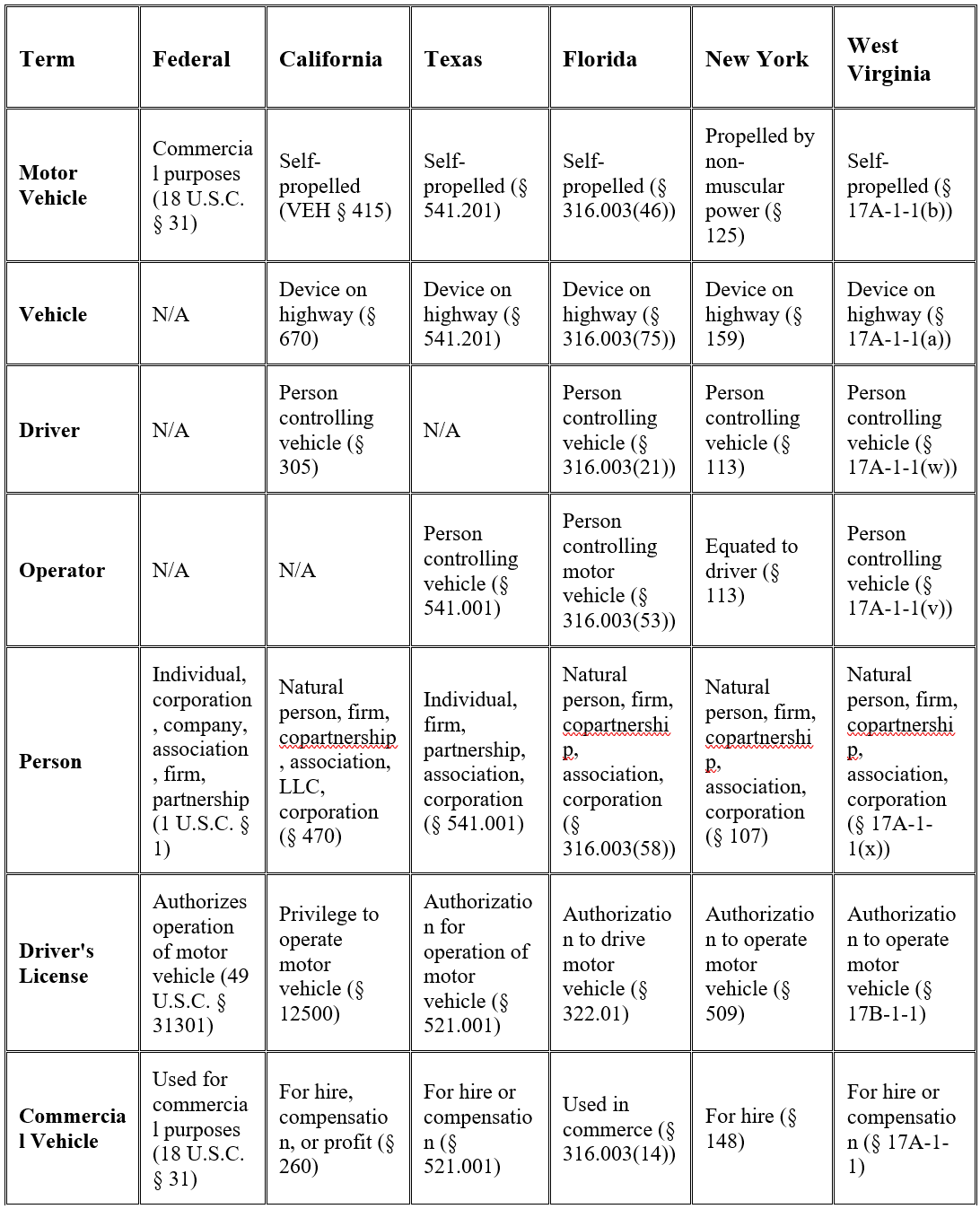
Table 2: The CDL vs. Driver’s License — Subsets of the Same Commercial Framework
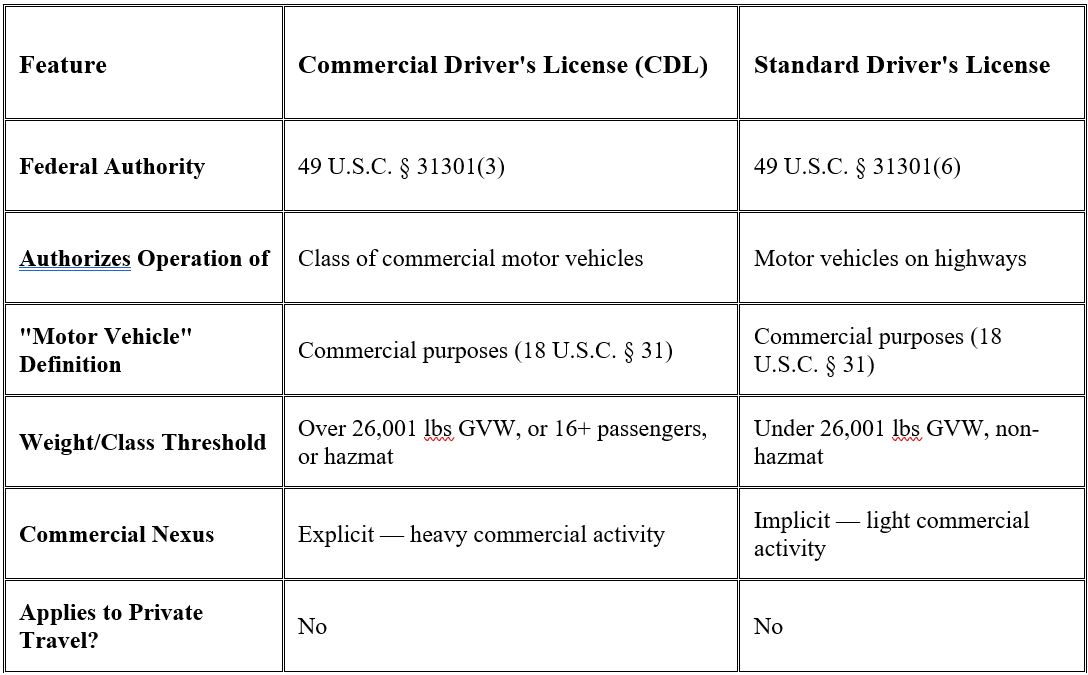
Table 3: Certificate of Title and Registration — Commercial Nexus

XI. The Canons Applied: Dismantling the Counter-Argument
The counter-argument that a driver’s license is not a commercial driver’s license and therefore applies to all travel, can now be addressed with precision.
Step 1: What does “driver’s license” authorize? It authorizes the operation of a “motor vehicle.” (All jurisdictions.)
Step 2: What is a “motor vehicle”? At the federal baseline, it is a contrivance used for commercial purposes. (18 U.S.C. § 31.) At the state level, it is a self-propelled vehicle, a term of art defined within a code that is structured around the commercial use of vehicles.
Step 3: Who is required to hold the license? A “person.” In every jurisdiction, “person” is defined to include corporations, firms, partnerships, and associations; all artificial, commercial entities. Under noscitur a sociis, the natural person in this list is the natural person acting in a commercial capacity.
Step 4: Is the CDL/driver’s license distinction a commercial/non-commercial distinction? No. Both licenses authorize the operation of “motor vehicles.” The CDL authorizes the heavier class; the standard license authorizes the lighter class. Both are subsets of the commercial regulatory framework. The distinction is one of degree, not of kind.
Step 5: Does the absence of the word “commercial” in the standard driver’s license definition mean it applies to non-commercial travel? No. Under the whole-statute rule, the term “motor vehicle” in the driver’s license definition carries its commercial meaning from the definitional section. The absence of the word “commercial” in the driver’s license definition does not sever the commercial nexus; it merely reflects that the commercial nexus is established by the definition of “motor vehicle,” not by the definition of the license itself.
Step 6: What about the “public safety” argument? The argument that licensing is required for public safety, independent of commercial activity, is a policy argument, not a statutory argument. The legislature may have public safety motivations, but the legislature must express those motivations in statutory text. The text, as written, establishes a commercial regulatory framework. A court may not substitute its own policy preferences for the legislature’s chosen text. Chevron U.S.A., Inc. v. Natural Resources Defense Council, 467 U.S. 837 (1984) (courts defer to statutory text, not to administrative policy preferences).
XII. Conclusion: The Statutory Text Speaks for Itself
The argument that a driver’s license applies to all travel, that vehicle registration is required for all conveyances on the public right-of-way, and that certificates of title are mandatory for all vehicles regardless of commercial use, is not supported by the statutory text of any jurisdiction examined in this analysis. It is supported by administrative practice, by judicial habit, and by the training materials of private corporations like Lexipol Media Group. But administrative practice and judicial habit are not law. The text is law.
When the text is read as a whole, when the terms of art are given their statutory meanings, when the canons of construction are applied consistently, the conclusion is the same in every jurisdiction: the commercial regulatory framework governs commercial activity. The man or woman traveling privately, in a personal conveyance, with no commercial nexus, is not within the scope of that framework.
The true “pseudo-legal” argument is the one that reads the word “person” in a list of corporations and firms and concludes that it means all human beings in all circumstances. The true “pseudo-legal” argument is the one that reads “motor vehicle”, a term defined as a commercial contrivance and concludes that it means every automobile on the road. The true “pseudo-legal” argument is the one that reads a licensing statute, a grant of permission to engage in a commercial privilege and concludes that it applies to the exercise of a fundamental right.
The statutes, the canons, and the binding precedents say otherwise.

References
[1] California Civil Code § 22.2 (West 2024).
[2] Texas Civil Practice and Remedies Code § 5.001(a) (West 2024).
[3] Florida Statutes § 2.01 (2024).
[4] West Virginia Code § 2-1-1 (2024).
[5] N.Y. Const. art. I, § 14.
[6] Texas Government Code § 311.005(2) (West 2024).
[7] California Government Code § 17 (West 2024).
[8] Florida Statutes § 1.01(3) (2024).
[9] West Virginia Code § 2-2-10(a)(9) (2024).
[10] Hooven & Allison Co. v. Evatt, 324 U.S. 652 (1945).
[11] Bouvier, J. (1856). A Law Dictionary, Adapted to the Constitution and Laws of the United States. Childs & Peterson.
[12] 26 C.F.R. § 1.871-2(b) (2024).
[13] Vattel, E. d. (1758). The Law of Nations (Book I, Ch. 19, § 218).
[14] Singer, N. J., & Singer, S. (2007). Sutherland Statutes and Statutory Construction (7th ed., Vol. 3, § 61:1). Thomson Reuters.
[15] Morissette v. United States, 342 U.S. 246 (1952).
[16] Crandall v. Nevada, 73 U.S. 35 (1868).
[17] Kent v. Dulles, 357 U.S. 116 (1958).
[18] Murdock v. Pennsylvania, 319 U.S. 105 (1943). https://supreme.justia.com/cases/federal/us/319/105/
[19] Murdock v. Pennsylvania, 319 U.S. 105 (1943).
[20] 18 U.S.C. § 31 (2024). https://uscode.house.gov/view.xhtml?req=granuleid:USC-prelim-title18-section31
[21] 49 U.S.C. § 31301 (2024). https://uscode.house.gov/view.xhtml?req=granuleid:USC-prelim-title49-section31301
[22] California Vehicle Code § 670 (West 2024).
https://leginfo.legislature.ca.gov
[23] California Vehicle Code § 415 (West 2024).
https://leginfo.legislature.ca.gov
[24] California Vehicle Code § 305 (West 2024).
https://leginfo.legislature.ca.gov
[25] California Vehicle Code § 470 (West 2024).
https://leginfo.legislature.ca.gov
[26] California Vehicle Code § 260 (West 2024). https://codes.findlaw.com/ca/vehicle-code/veh-sect-260/
[27] California Vehicle Code § 12500 (West 2024).
https://leginfo.legislature.ca.gov
[28] Texas Transportation Code § 541.201 (West 2024).
https://statutes.capitol.texas.gov
[29] Texas Transportation Code § 541.001 (West 2024).
https://statutes.capitol.texas.gov
[30] Texas Transportation Code § 521.001 (West 2024). https://codes.findlaw.com/tx/transportation-code/transp-sect-521-001/
[31] Florida Statutes § 316.003 (2024). https://codes.findlaw.com/fl/title-xxiii-motor-vehicles/fl-st-sect-316-003/
[32] New York Vehicle and Traffic Law § 125 (McKinney 2024). https://codes.findlaw.com/ny/vehicle-and-traffic-law/vat-sect-125/
[33] New York Vehicle and Traffic Law § 113 (McKinney 2024). https://law.justia.com/codes/new-york/vat/title-1/article-1/113/
[34] New York Vehicle and Traffic Law § 107 (McKinney 2024). https://newyork.public.law/laws/n.y._vehicle_&_traffic_law_section_107
[35] West Virginia Code § 17A-1-1 (2024). https://codes.findlaw.com/wv/chapter-17a-motor-vehicle-administration-registration-certificate-of-title-and-antitheft-provisions/wv-code-sect-17a-1-1/
[36] California Vehicle Code § 4000 (West 2024).
https://leginfo.legislature.ca.gov
[37] West Virginia Code § 17A-3-1 (2024).
https://codes.wv.gov
[38] Rawle, F. (Ed.). (1914). Bouvier’s Law Dictionary and Concise Encyclopedia (8th ed., Vol. 2). West Publishing Company. (Citing William Blackstone, Commentaries on the Laws of England, Book I, Ch. 1).
[39] American Jurisprudence (1st ed., Vol. 11, Constitutional Law, § 329). (1938). Lawyers Co-operative Publishing Company.
[40] Thompson v. Smith, 155 Va. 367, 154 S.E. 579 (1930). https://case-law.vlex.com/vid/thompson-v-smith-893892661
[41] Aptheker v. Secretary of State, 378 U.S. 500 (1964). https://supreme.justia.com/cases/federal/us/378/500/
[42] Reno v. Condon, 528 U.S. 141 (2000). https://supreme.justia.com/cases/federal/us/528/141/
[43] 49 U.S.C. § 13102 (2024). https://uscode.house.gov/view.xhtml?req=granuleid:USC-prelim-title49-section13102
[44] 49 U.S.C. § 31132 (2024). https://uscode.house.gov/view.xhtml?req=granuleid:USC-prelim-title49-section31132
Excellent legal analysis of the "Commercial Vehicle Code." The misnomer of "Law Enforcement" needs a thorough education in this specific area of law. I often inquire of law enforcement officers how they enforce the 4 laws of therrmo dynamics? Then have to simplify the question to how do you enforce gravity? Natural laws don't require enforcement, which is what make them laws. I've yet to get any legitimate answer other than one officer who stated " I don't know how to answer that question." At least he was honest.
Thank you for dropping this analysis. I have three questions about this. One is about the definition of a driver. A driver is either a person engaged in transportation of goods, or, he is the one doing the driving. This is a catch 22. Either you're employed in international commerce, or, you're operating a motor vehicle. Either way, you still need a driver's license. 1) Could this catch 22 be used to claim that the holder of a driver's license is in the employ of the municipal contractor who issues it? 2) Could that claim in turn be used to purchase Dead Peasant Life Insurance in the Driver's name?
3) Could a criminal or civil trial for the murder or attempted murder of the driver create a situation that would force disclosure of Dead Peasant Life Insurance polices in an attempt to discover motive? Do you see what I'm driving at? Federal and Municipal contractors could claim that we are their employees, then purchase Dead Peasant Life insurance policies in our names, then create the condition (such as forced poison injections) to cash out those policies. Life insurance policies have been used to establish motive in many murder cases and attempted murder cases, and employers have been found guilty of doing this very thing...buying Dead Peasant insurance then designing working conditions to kill their employees. Is there any other legal framework for forcing disclosure of Dead Peasant Life Insurance held in one's name? How can we force disclosure?